


Struggling With Painful Feelings

I arrived back in Belfast in September 2024. Returning home, I had many positive conditions. I had bought a small house in 2000, and the mortgage had just been paid off. With fewer financial constraints and by living simply, I could sustain myself with a job that paid less, but was more rewarding. I also had family and friends living close by. At the same time, I was living alone, as my wife was devoting time to looking after her elderly mother. After receiving so much from living in community, living alone felt like a step backwards, the antithesis of my aspiration to live in community.
Alongside this, I also had all the everyday responsibilities of being a householder, in a house that had lacked some basic care during years of being rented out.
In the midst of all this, and after a lifetime of structured living and working, this was the first time that I had no externally imposed structure to my life. I was more or less free to do what I liked, when I liked. On the surface, this sounds wonderful.
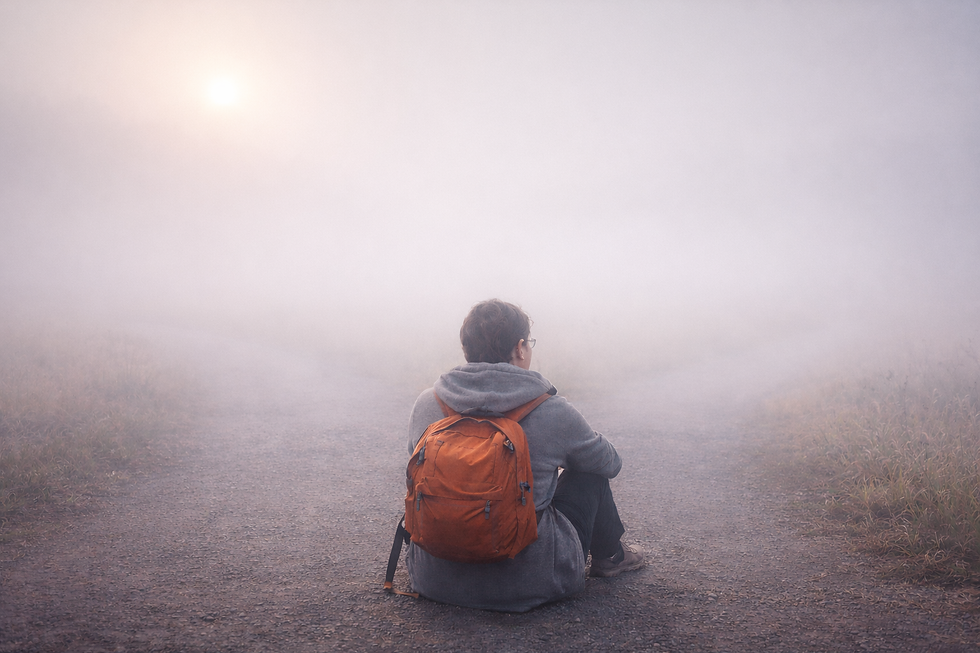
In all this space, when difficult emotions arose, I would feel as if I were falling backwards. At times, this path can feel like climbing a mountain. I was putting in effort, trying to make progress, and when I lost my footing and began to slide, it felt as though that slide would not stop. This would then bring up a lot of fear and despair.

I remember one particular time. My wife had been staying for the weekend and had just returned to care for her mother. I was experiencing loss and despair and didn’t want to be with those feelings. I could feel a strong desire to distract myself through consuming. This time, I thought, I won’t judge or resist this; I’ll just observe what happens.
In hindsight, I can see that I had a silent expectation. The deal with my suffering was something like this: I let go and stop trying to control, and you stop of your own accord. There did come a point when I had had enough—but it was much more than I had anticipated.
The waves of ups and downs continued through 2025. I practised as well as I could, still often becoming overwhelmed and taking refuge in consumption, always trying to remain compassionate and accepting of what was happening, with greater or lesser success.
It was during this time that I came across the documentary The Weight of Gold, in which world-class Olympic athletes speak openly about the difficulties they have had with their mental health. Hearing people we might see as ultra-successful admit their struggles helped me to say something I had been finding difficult to admit: that I was struggling with painful feelings of my own.
This was not easy for me to admit, either to myself or to others. After all the personal work I had done in my life, how could I still be struggling?
And as a practitioner and a teacher, how could I wholeheartedly recommend mindfulness to others, when I was still finding things so difficult myself?
It’s not that I can’t see the transformation in my life. But when we are caught in our difficulties, that perspective disappears. When we fall into a deep hole, we lose sight of the horizon—that’s just the nature of being in a hole.
Something shifted when I was able to say to myself, and to others, “I’m really struggling right now.”
When I stopped fighting against my experience and admitted that, even after all these years, I was still overwhelmed at times by what I was feeling, something softened. In letting go of the idea that there would one day come a time when I no longer experienced difficult emotional states, I could see that what I was really struggling with was not so much my emotions, but the belief that I shouldn’t be experiencing them.
In that space, I could see that I can’t really control the coming and going of many things—and that trying to do so isn’t helpful. I can see this very clearly in my breathing: the in-breath and the out-breath. We can’t hold on to the in-breath; it has to be allowed to move freely. And it’s the same with our emotions. In many ways they are like water. When they have the space to flow, they remain fresh, vibrant, and life-giving. When they are blocked or resisted, they can become stagnant—a source of ill-being.
I know that for many people, suffering does not always flow in this way, and can often feel deeply intractable. I offer this simply as one experience among many, with care and respect for all those whose pain may not ease so readily.
As I became more at ease and accepted that difficult emotions would continue to arise in my life at times, I could see that struggling against these painful feelings only strengthened them—whatever we resist tends to persist.
By stopping the habitual pushing away of unpleasant feelings, and by gently turning towards them, something changed. I began to notice where I was resisting—bracing, tensing, contracting—in both body and mind. As I softened and relaxed, and stopped struggling against what was present, my experience was able to flow more freely.
From all this, I can see two clear benefits.
First, when I stop resisting what is happening in the present moment and let it flow, I suffer much less straightaway.
Second, when I accept what is painful and turn towards it with compassion, I can begin to understand my suffering.

Like waves on the sea, our emotional world will continue to break on the shore of our being—sometimes gently, and sometimes with such force that it feels as though we might not survive the onslaught. Even King Canute, for all his power, knew that he could not command the tide to turn. In the same way, we cannot stop the waves from coming. But when we stop fighting them, and learn instead to meet them with kindness and understanding, we discover a quiet steadiness within us that the waves themselves cannot take away.
Dear friends, if something here feels helpful, you’re very welcome to share it with others.


Wonderful article on embracing difficult feelings, Mark. A lifetime exploration for me, for sure!